Hello and welcome to the details of Energy-rich Turkmenistan’s gas riches flow to China, raising fears of overdependence and now with the details
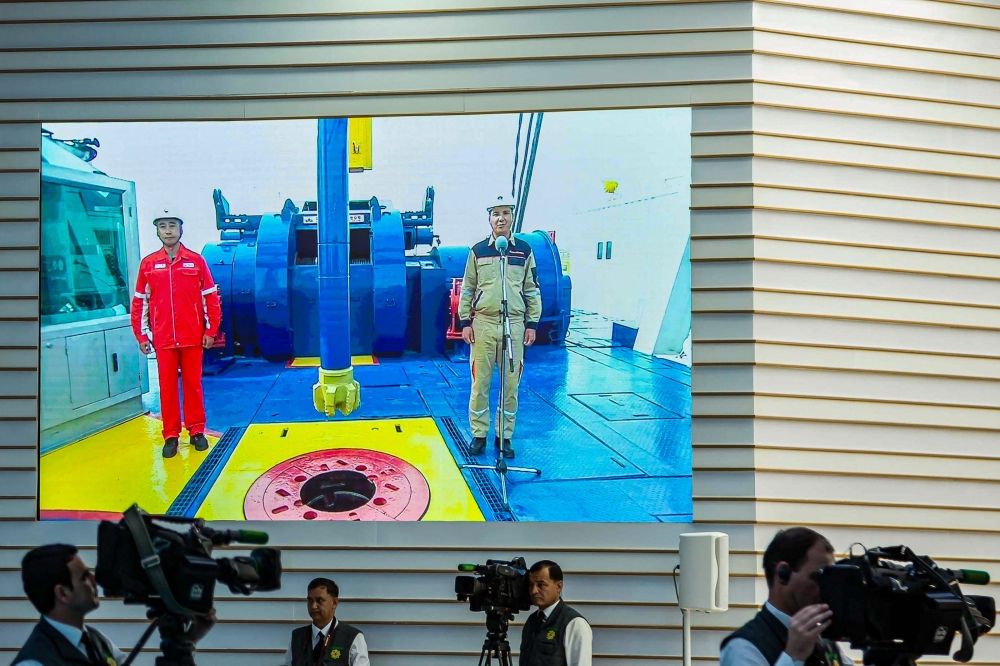
Nevin Al Sukari - Sana'a - A huge screen broadcasts the launching ceremony of the fourth of seven planned development phases at Galkynysh gas field, the world’s second-largest gas field in the Karakum desert about 400 kilometres (250 miles) east of Turkmenistan’s capital Ashgabat, on April 17, 2026. — AFP pic
YOLOTEN (Turkmenistan), April 21 — In the desert expanse of Turkmenistan, Chinese engineers are hard at work at the vast Galkynysh gas field – a mega project that is deepening the closed Central Asian state’s already extensive ties with Beijing.
Energy-rich Turkmenistan, one of the world’s most reclusive and sealed-off states, has stated its desire to diversify its exports towards Europe and the Indian subcontinent.
But it is China that is pouring in the cash to get its hands on Turkmenistan’s vast gas reserves, estimated to be the fourth largest in the world.
At the inauguration of a new phase of the Galkynysh plant in mid-April, Gurbanguly Berdymukhamedov – former president and now father of the nation – hailed the country’s important ties with Beijing.
“Our country regards China as a strategic partner,” he said at the event, to which AFP journalists were granted rare access.
Berdymukhamedov touched down at the ceremony in a white helicopter, where a traditional carpet was laid out across the tarmac.
Standing alongside China’s Vice Premier Ding Xuexiang, dancers in the countries’ respective national colours performed a routine symbolising the handover of gas from one to another.
Hundreds of green Turkmen flags fluttered in the desert wind, held up by women in red, purple, blue and green outfits.
Led by the state-owned China National Petroleum Corporation (CNPC), the expansion will increase production and storage at Galkynysh, enabling more exports to China.
The site is the second-largest gas field in the world, according to British energy consultancy Gaffney, Cline and Associates, behind only South Pars, shared by Iran and Qatar.
Around 90 percent of Turkmenistan’s gas exports already go to China – according to several independent estimates.
Ashgabat does not publish statistics.
“The paradox of Turkmenistan is that as its proven gas reserves have grown, the country has gained the status of a gas giant, but not a comparable degree of freedom in monetising those reserves,” said Abzal Narymbetov, an expert in Central Asia’s energy sector.
“The country has a huge resource base, but its export infrastructure is still heavily tied to the Chinese route,” he added.
‘Strategic vulnerability’
A former Soviet republic, Turkmenistan used to export gas exclusively to Russia until 2009, when a diplomatic spat with Moscow accelerated a pivot towards Beijing.
The Central Asia-China gas pipeline, opened that year, has since delivered “around 460 billion cubic metres (bcm) of natural gas,” Berdymukhamedov said.
He wants to increase annual deliveries to 65 bcm.
China, the world’s largest importer of natural gas, is a major buyer from Russia and the Middle East, but seeks to diversify its energy sources.
“For Turkmenistan, China is irreplaceable, whereas for China, Turkmenistan is just one of several suppliers. That is why dependence on a single market is not just a trade issue but one of strategic vulnerability,” Narymbetov said.
Turkmen authorities are also hoping the expanded field at Galkynysh could help it look further afield.
“In addition to the Chinese route, Galkynysh is also being considered as a resource base for the future TAPI (Turkmenistan-Afghanistan-Pakistan-India) gas pipeline,” an employee of state-owned Turkmengaz told AFP, speaking on condition of anonymity.
It is aiming to supply 33 bcm along that route as well as boosting exports to Europe via the Caspian Sea on the country’s west.
‘Reinforce’
For now, Beijing is the only viable route.
“Each new phase of Galkynysh so far tends to reinforce the Chinese vector rather than genuinely diversify it,” Narymbetov said.
The already-delayed TAPI route faces security challenges in Afghanistan, where it is still under construction.
And the proposed Trans-Caspian pipeline to take Turkmen gas across the Caspian Sea and into Europe, is stalling.
There is no clear agreement on who will finance that project, or long-term gas deals that would make it financially viable.
Asked by AFP, the EU delegation in Turkmenistan said: “We leave a decision on a potential Trans-Caspian Pipeline to Turkmenistan, Azerbaijan, and/or other parties interested in investing in it financially.”
At home, the partnership with Beijing is, for now, an economic lifeline, with authorities presenting Galkynysh as a source of prosperity for the entire country.
Aga, a 22-year-old student at the oil-and-gas university in the capital Ashgabat, told AFP investment at the field was creating many jobs.
“After I graduate, I would like to work there,” he said. — AFP
These were the details of the news Energy-rich Turkmenistan’s gas riches flow to China, raising fears of overdependence for this day. We hope that we have succeeded by giving you the full details and information. To follow all our news, you can subscribe to the alerts system or to one of our different systems to provide you with all that is new.
It is also worth noting that the original news has been published and is available at Malay Mail and the editorial team at AlKhaleej Today has confirmed it and it has been modified, and it may have been completely transferred or quoted from it and you can read and follow this news from its main source.