



Thank you for reading the news about Hajj pushes AI telecom systems to the limit and now with the details
Jeddah - Yasmine El Tohamy - ALKHOBAR: Every year during Hajj, millions of pilgrims converge within a tightly concentrated geographic area over the span of just a few days, creating one of the most complex and demanding connectivity environments in the world.
Unlike most large-scale global gatherings, Hajj combines extraordinary population density with highly synchronized movement patterns, generating intense and constantly shifting network demand across Makkah and the holy sites.
As Saudi Arabia accelerates the expansion of its digital infrastructure under Vision 2030, telecom operators are increasingly deploying artificial intelligence and network automation technologies to manage the scale, speed and operational complexity of Hajj in real time.
“Hajj combines one of the highest human densities in the world with extreme time and space constraints,” said Patrick Johansson, president and head of Market Area Europe, Middle East and Africa at Ericsson.
“Millions of pilgrims move simultaneously through compact areas, creating intense, synchronized traffic peaks.”
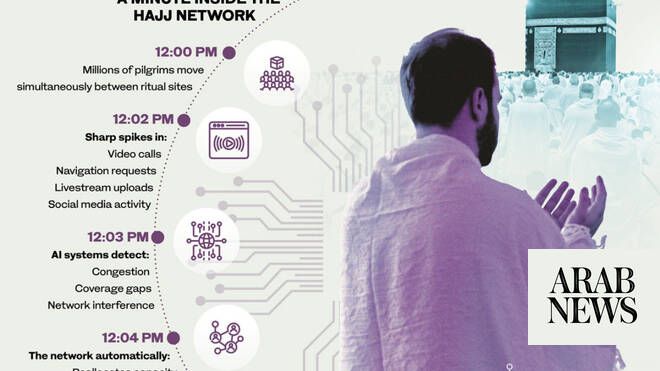
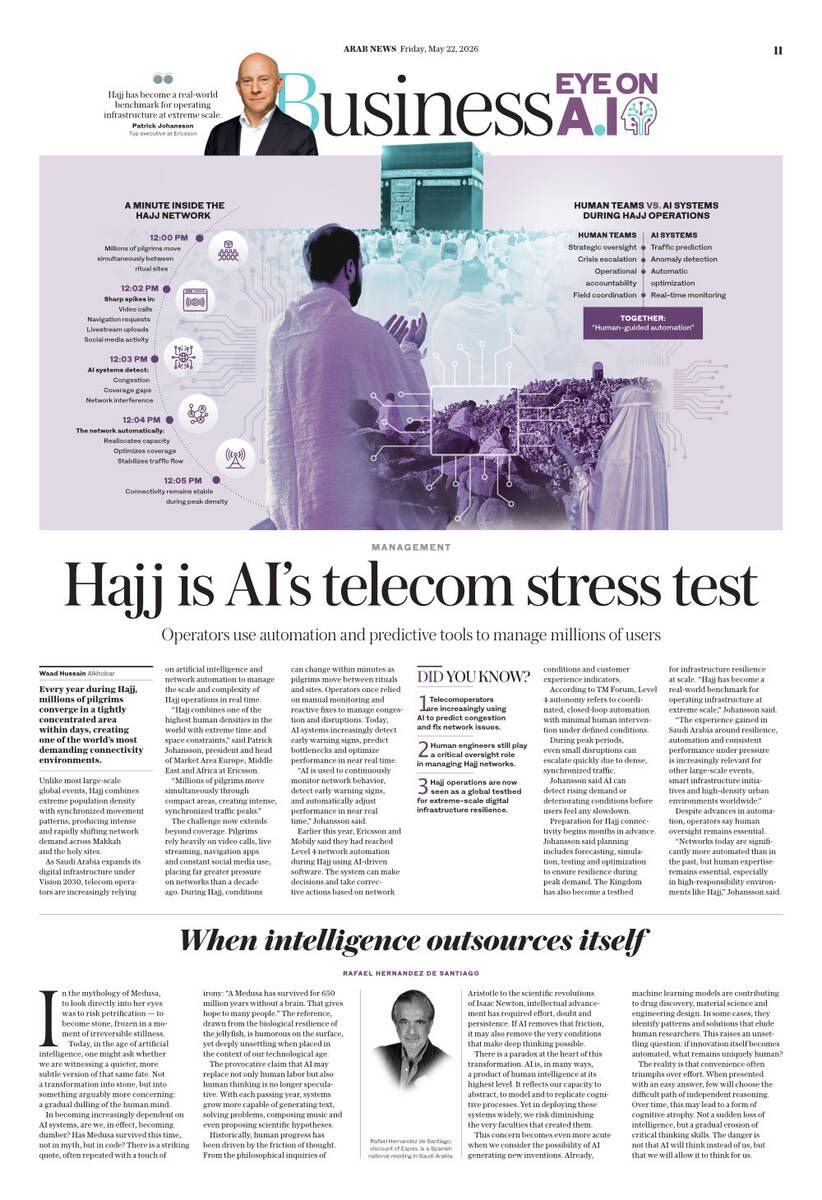
The challenge today extends far beyond maintaining basic network coverage. Pilgrims now depend heavily on video calls, live-streaming, navigation platforms and continuous social media access, placing unprecedented pressure on telecom infrastructure compared with a decade ago.
“Ten years ago, usage was intermittent; today, connectivity is always on and always expected,” Johansson said.
That evolution has compelled telecom operators to move beyond traditional, manually managed network systems.
Telecom operators increasingly rely on AI-powered automation and real-time monitoring systems to manage network performance during Hajj. (Creative Commons)
During Hajj, network conditions can shift within minutes as pilgrims move between rituals and locations. In previous years, operators often relied on manual monitoring and reactive troubleshooting to manage congestion or service disruptions.
Today, AI-powered systems are increasingly being used to identify early warning signs, predict traffic bottlenecks and automatically optimize network performance in near real time.
“AI is used to continuously monitor network behavior, detect early warning signs, and automatically adjust performance in near real time,” Johansson said.
He explained that AI-enabled systems can detect congestion, interference and coverage gaps, then respond automatically before users experience any service disruption.
The approach reflects a broader industry transition toward autonomous telecom networks, where AI increasingly manages operational decisions previously handled manually by engineers.
Earlier this year, Ericsson and Mobily announced they had achieved Level 4 network management automation during Hajj operations using AI-driven software designed to optimize network performance. Ericsson said the system was capable of independently making decisions and taking corrective actions based on network conditions and customer experience indicators.
According to TM Forum, Level 4 autonomy refers to networks capable of coordinated, closed-loop automation with minimal human intervention under defined operating conditions.
During peak movement periods, even minor disruptions can escalate rapidly because of the concentration of users and synchronized traffic surges.
DID YOU KNOW?
Telecom operators are increasingly using AI to predict congestion and fix network issues.
Human engineers still play a critical oversight role in managing Hajj networks.
Hajj operations are now seen as a global testbed for extreme-scale digital infrastructure resilience.
Johansson said AI systems are now capable of identifying rising demand or deteriorating network conditions before users experience slowdowns.
“Rather than waiting for users to experience slowdowns or disconnections, the system automatically adjusts capacity and coverage in advance, often within minutes,” he said.
He added that predictive optimization helped address potential bottlenecks — including congestion in indoor facilities and uplink interference — before they developed into larger operational challenges.
Preparation for Hajj connectivity operations begins months before pilgrims arrive.
Johansson said the process includes forecasting, network simulation, infrastructure testing and extensive optimization efforts to ensure resilience during peak demand periods.
The scale of that preparation reflects the broader transformation taking place across Saudi Arabia’s digital infrastructure ecosystem, where AI is increasingly embedded into core operational systems rather than treated as a standalone technology layer.
The Kingdom has also emerged as a global testing ground for infrastructure resilience at scale.
Video calls, livestreaming and navigation apps have significantly increased network demand during Hajj compared to a decade ago. (Creative Commons)
“Hajj has become a real-world benchmark for operating infrastructure at extreme scale,” Johansson said.
“The experience gained in Saudi Arabia around resilience, automation and consistent performance under pressure is increasingly relevant for other large-scale events, smart infrastructure initiatives and high-density urban environments worldwide.”
Despite the rapid advancement of automation technologies, telecom operators say human oversight remains critical.
“Networks today are significantly more automated than in the past, but human expertise remains essential, especially in high-responsibility environments like Hajj,” Johansson said.
He described the current phase of development as “human-guided automation,” where AI delivers speed and scale while operational teams maintain oversight, governance and accountability.
Connectivity itself has also become central to the overall pilgrim experience. Digital infrastructure now underpins communication, navigation, operational coordination and access to essential services throughout the pilgrimage journey.
“Connectivity enables communication, coordination, safety and reassurance,” Johansson said.
As Saudi Arabia continues expanding its digital infrastructure under Vision 2030, Hajj is increasingly serving as a real-world testing ground for how AI-driven systems can manage infrastructure at extreme scale.
The technologies and operational models being refined during the pilgrimage are also beginning to shape broader global conversations around automation, resilience and real-time network management far beyond Saudi Arabia.
These were the details of the news Hajj pushes AI telecom systems to the limit for this day. We hope that we have succeeded by giving you the full details and information. To follow all our news, you can subscribe to the alerts system or to one of our different systems to provide you with all that is new.
It is also worth noting that the original news has been published and is available at Arab News and the editorial team at AlKhaleej Today has confirmed it and it has been modified, and it may have been completely transferred or quoted from it and you can read and follow this news from its main source.