
Hello and welcome to the details of How French students’ viral ‘Bismillah’ chant reflects race and policing tensions amid protests and now with the details
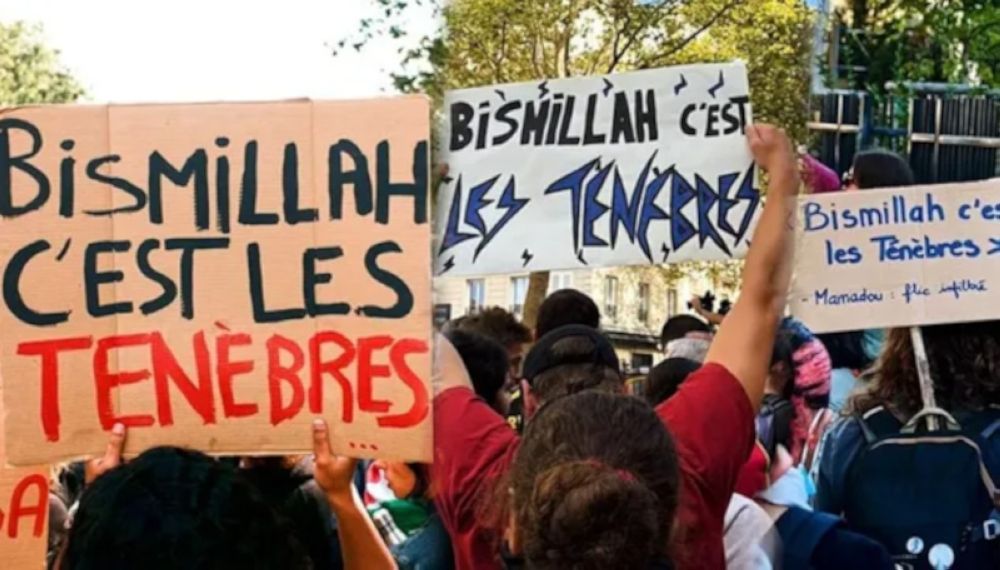
Nevin Al Sukari - Sana'a - The chant ‘Bismillah, c’est les ténèbres’ has gained traction as protesters ridicule what they see as a clumsy attempt by police to imitate young demonstrators, Al Jazeera reported. — Social media pic
By Malay Mail
First Published: Thursday, 22 Oct 2026 10:53 AM MYT
PARIS, Oct 22 — A phrase blending Arabic and French slang has become an unlikely symbol of youth dissent in France, where protests over education, living costs and inequality have also fuelled criticism of police conduct and racial stereotyping.
The chant “Bismillah, c’est les ténèbres” has gained traction as protesters ridicule what they see as a clumsy attempt by police to imitate young demonstrators, Al Jazeera reported.
The phrase first attracted attention after a screenshot of a Snapchat exchange circulated online in early October, showing a user called Mamadou asking to join a group chat used to coordinate protest activity.
The message read: “Hi, in the name of God, it’s the darkness. When’s the blockade, wallah, bro?” and included emojis depicting Algerian flags.
Students suspected the sender was an undercover officer attempting to enter their chats, interpreting the mixture of Arabic expressions and slang as an unconvincing imitation of the way young people communicate.
That claim has not been verified, however, and French authorities have not issued a public statement on the alleged incident.
Why has the phrase caught on?
Its appeal lies less in its literal meaning than in the mockery it conveys, with students using it to challenge stereotypes about young people of Arab and African descent and portray authorities as disconnected from their lives.
“Bismillah” means “in the name of God” in Arabic and is commonly said by Muslims before beginning an activity, while in French slang it can carry a meaning closer to “let’s do it”.
The French words “c’est les ténèbres” translate literally as “it’s the darkness”, evoking bleakness or hopelessness, but the combined expression does not form a clear message on its own.
Youssef El Chazli, an associate professor in Arab and Mediterranean sociology at Paris 8 University Vincennes–Saint-Denis, said the slogan reinforced the image of police officers as out of touch and shaped by stereotypes.
He told Al Jazeera that such stereotypes appeared to disproportionately target young people of Arab and African descent, and reflected a wider disconnect between state agencies and the protest movement.
What does it reveal about the wider unrest?
The chant has appeared on cardboard placards and spread beyond France to Italy and Belgium, where demonstrations over the cost of living and education also took place over the weekend.
The protests in France have brought together people angered by a range of issues, including overcrowded classrooms, teacher shortages, inequality and limited opportunities, while allegations of police violence have added to tensions.
The scale of mobilisation grew over the weekend, when hundreds of thousands took to the streets nationwide in the largest demonstrations since protests against education reforms and rising prices began last month.
France’s police inspectorate, the IGPN, has opened dozens of investigations into alleged police violence linked to the demonstrations.
El Chazli said political humour and online trends were established ways for protesters to express grievances, with younger demonstrators often drawing on their own cultural references and subcultures.
How does Islamophobia fit into the debate?
The slogan has circulated amid broader public discussion about anti-Muslim hostility in France, where authorities have faced criticism over their response to concerns about Islamophobia.
A report cited by Reuters recorded a 72 per cent increase in Islamophobic incidents in France between January and March 2025 compared with the same period in 2024.
French far-right figures have used racist language to blame Muslim youths for the violence, while United States President Donald Trump claimed the unrest was about “Islam wanting to take over”.
El Chazli said Arab and African influences had become increasingly prominent in youth culture over the past two decades, through sports and arts figures, radio programmes and social media content.
These were the details of the news How French students’ viral ‘Bismillah’ chant reflects race and policing tensions amid protests for this day. We hope that we have succeeded by giving you the full details and information. To follow all our news, you can subscribe to the alerts system or to one of our different systems to provide you with all that is new.
It is also worth noting that the original news has been published and is available at Malay Mail and the editorial team at AlKhaleej Today has confirmed it and it has been modified, and it may have been completely transferred or quoted from it and you can read and follow this news from its main source.