
Hello and welcome to the details of ‘Warning to Spain’: Did Morocco deliberately trigger the Ceuta migrant surge? and now with the details
Nevin Al Sukari - Sana'a - TUNIS, Aug 5 — Witnesses and experts have suggested to AFP that an easing of controls by Morocco in the border area of Ceuta contributed to the recent mass influx of migrants into the Spanish enclave.
If so, what interests could Rabat have been trying to advance?
Here is what we know:
Did Morocco deliberately ease controls?
According to witnesses interviewed by AFP, thousands of people who flocked to the border town of Fnideq were not stopped by blockades.
“There were ordinary gendarmerie checkpoints on the roads, but not an exceptional deployment,” a source close to the removal operations told AFP.
North Africa analyst Pierre Vermeren said Morocco’s police were “very effective, very organised and very well-informed”, and argued that they “could have blocked the roads” had they wanted to stop those headed for the border.
Mohamed Benaissa, head of the Northern Observatory for Human Rights (ONDH) in Fnideq, said “we observed that the security measures had been reduced” in downtown Fnideq.
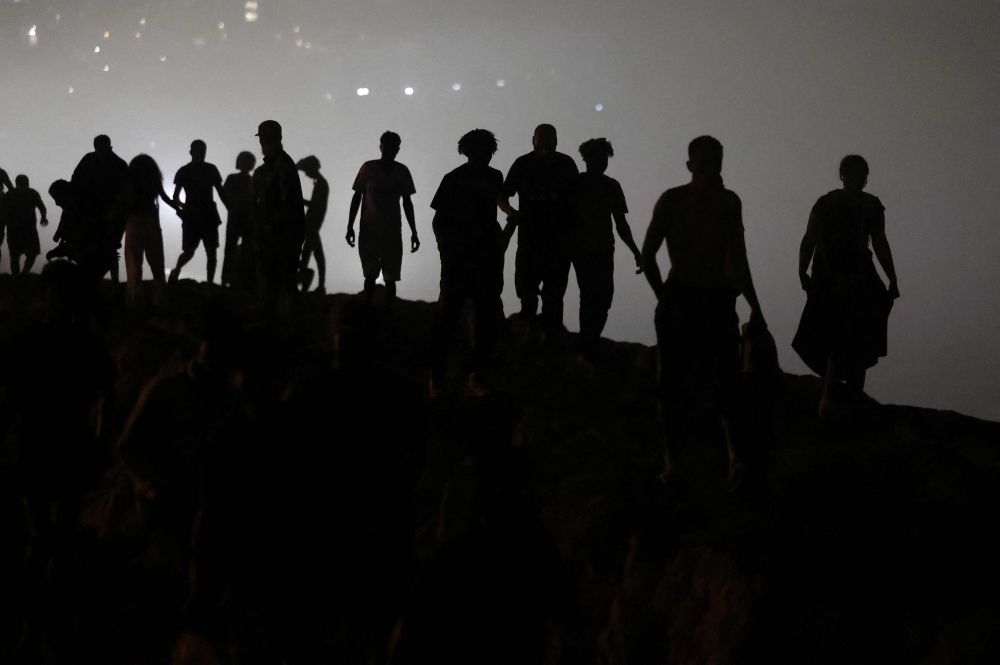
Migrants walk towards the Fnideq region in northern Morocco after leaving Spain’s North African enclave of Ceuta following an attempted crossing at the Bab Sebta border crossing on the outskirts of Fnideq on August 1, 2026. — AFP pic
He added that “police reinforcements only arrived on Thursday at around 7:00 pm”, after hundreds of migrants had already entered Ceuta in previous days.
No evidence of a decision taken at the highest level of the Moroccan state has emerged.
But Riccardo Fabiani, North Africa director at the International Crisis Group, said that “by now we have enough elements to suggest that Rabat was involved in this crisis”.
He mentioned “testimonies from Moroccan migrants... as well as videos showing passive security forces vis-a-vis truckloads of migrants”. AFP could not verify the footage.
Haizam Amirah Fernandez, director of the Center for Contemporary Arab Studies in Madrid, said that “knowing how the Moroccan state functions, it’s difficult to believe that the authorities... were not aware of what was happening or even facilitated such a massive movement of people”.
On Monday, a Moroccan source close to the case denied to AFP any “relaxation” at the land border crossing. On Sunday, the interior ministry blamed the sudden surge on the “malicious exploitation” of social media and the “spread of misleading information”.
In light of the accusations against Rabat, several observers have pointed out that the surge occurred during Throne Day celebrations, when the authorities traditionally highlight the kingdom’s stability.
The Moroccan royal palace has not commented on the flow of migrants.
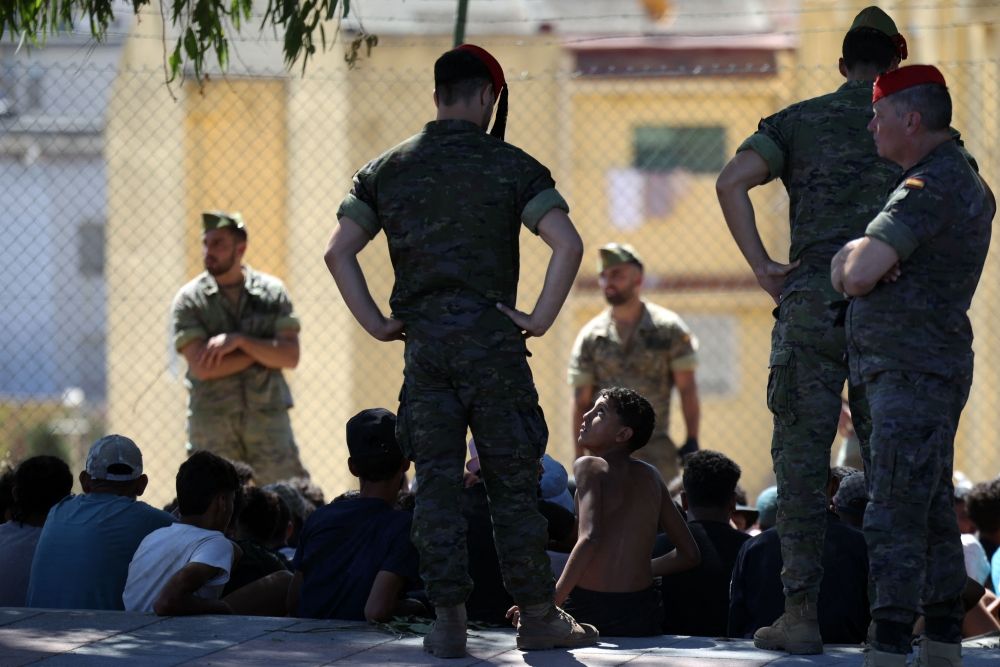
A young migrant looks at a member of the Spanish Army’s ‘Regulares’ infantry force near the border post, prior to escorting them back to Morocco, in the Spanish enclave of Ceuta on August 2, 2026. — AFP pic
What benefit could Rabat have seen?
For Vermeren, it was “a warning message sent to Spain” over Western Sahara, a former Spanish colony that is considered a non-self-governing territory by the United Nations.
Morocco has largely controlled the territory for decades, but has been in conflict with the Algerian-backed Polisario Front, which seeks independence for the Sahrawi people.
Vermeren believes the Spanish prime minister’s recent visit to Algiers may have angered Morocco.
During a similar surge in 2021, more than 10,000 migrants reached Ceuta from Morocco over the course of two days during a diplomatic spat between the two countries.
The row erupted after Spain decided to host for medical treatment a leader of the Polisario Front.
The crisis ended in 2022 when Madrid reversed its long-standing policy of neutrality and backed Morocco’s plan for Western Sahara – a move that caused a diplomatic rift between Madrid and Algiers.
Another crucial issue is that Morocco does not recognise Ceuta and Spain’s other north African enclave, Melilla, as Spanish territory and has claimed sovereignty over them since its independence in 1956.
Fabiani said that the recent events remind “Spain that Ceuta is still a disputed territory and is hard to defend, that Madrid needs Rabat to protect its interests in the area”.
This combination of pictures created on June 3, 2026 shows (from left) Israeli Prime Minister Benjamin Netanyahu in Jerusalem on March 19, 2026 and US President Donald Trump in Morristown, New Jersey, on May 22, 2026. AFP pic
US, Israel in the background
Some analysts have even gone so far as to bring up the United States and Israel in the context of the Ceuta events.
Fabiani said that the events could have also served for “Morocco to earn some credit with two key allies, Israel and the US”, which he said were “gloating about this situation”.
During the peak of the Ceuta influx, Danny Danon, Israel’s ambassador to the United Nations, noted on X Spain’s “state of emergency in Ceuta following the crisis over its immigration policy”.
“Maybe before it continues lecturing us, it’s time it explained to the world why it still maintains colonial enclaves in Africa,” he added.
Fabiani believes that “the US and Israeli right-wing officials and intellectuals incited Morocco to move onto Ceuta as a form of retaliation against Spain’s support for the Palestinians and its position during the Iran war”.
US President Donald Trump had criticised Spain at a Nato summit last month for failing to help with the war that the US and Israel launched against Iran in late February.
“They are not behaving nicely, but they will learn,” he had said.
Amirah Fernandez said “the fact that a massive arrival of people in Ceuta came a few weeks after Trump said that made many in Spain make the link”.
“Trump could want to punish Spain and frighten other European leaders – it’s a way of intimidation aiming at creating divisions within the EU, which is a goal of the current US administration,” he added. — AFP
These were the details of the news ‘Warning to Spain’: Did Morocco deliberately trigger the Ceuta migrant surge? for this day. We hope that we have succeeded by giving you the full details and information. To follow all our news, you can subscribe to the alerts system or to one of our different systems to provide you with all that is new.
It is also worth noting that the original news has been published and is available at Malay Mail and the editorial team at AlKhaleej Today has confirmed it and it has been modified, and it may have been completely transferred or quoted from it and you can read and follow this news from its main source.