Hello and welcome to the details of Vietnam wants a futuristic megacity by 2045 — and Hanoi residents are paying the price and now with the details
Nevin Al Sukari - Sana'a - HANOI, May 25 — Rows of townhouses torn down in hours, roads ripped up by bulldozers and city blocks reduced to rubble in the name of progress — giant construction sites litter Hanoi as it races ahead with urban renewal.
A “100-year master plan” for the Vietnamese capital includes new bridges, subway lines and riverside developments.
Hundreds of thousands could be displaced to make way for construction, authorities say, as the city of eight million prepares to accommodate twice as many people by 2045.
Communist leaders hope Vietnam will be a developed country by then, buoyed by breakneck growth and spurred by their huge infrastructure investments.
But the speed of implementation has unnerved residents, made some homeless and left many more fearing the same fate.
“I have never seen authorities acting that quick,” said Hung, a 51-year-old businessman whose house was torn down last month for a US$750 million (RM3 billion) bridge spanning the Red River.
“My dad had lived there all his life, he got to know every corner, everyone, now he saw it all demolished in a blink,” he added, asking to be identified only by his first name.
He said he received 10 billion dong as compensation along with a rural plot of land — but that the home’s market value was nearly triple that.
The city having another bridge is “good for all, but not for us”, he added.
“We are unlucky to be the sufferers in this giant restructuring of Hanoi.”
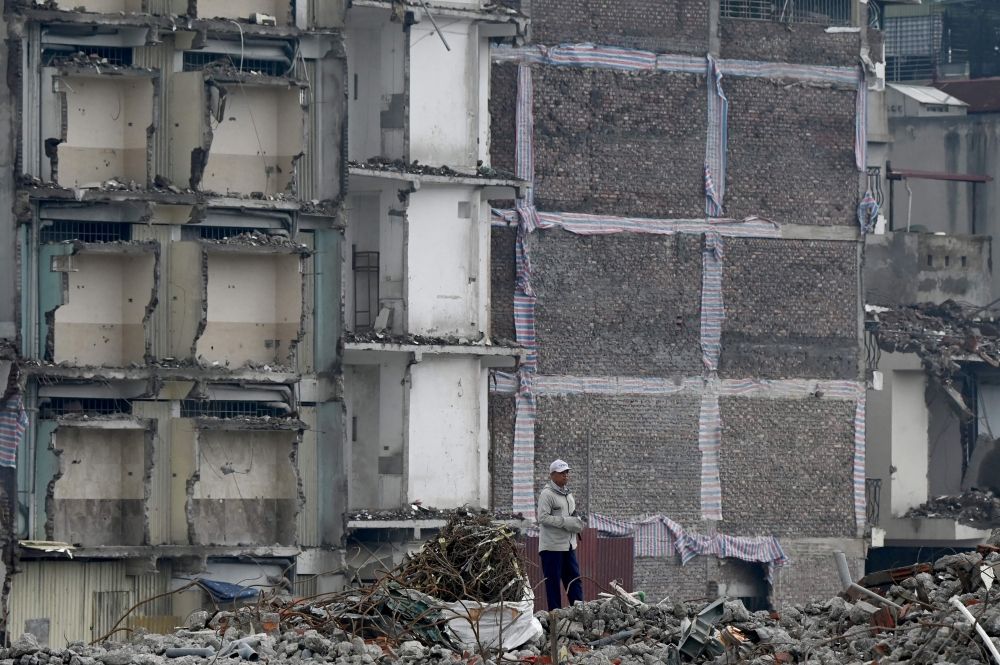
A man looks on at a demolition site of former residential buildings to make way for an expanded road network in Hanoi May 18, 2026. — AFP pic
No joke
A city of less than half a million for most of its thousand-year history, Hanoi grew dramatically in the 1980s and 1990s as Vietnam underwent market-oriented reforms.
Many migrants from the countryside built homes on land they did not formally own, creating sprawling, semi-planned neighbourhoods with narrow, winding streets.
The city has since formalised construction and embarked on multiple rounds of renovation.
But those plans “were often joked about because they stayed as posters on the wall and little was implemented”, according to Danielle Labbe, an urban planning professor at the University of Montreal who focuses on Vietnam.
Now the 100-year master plan is charging ahead.
Top leader To Lam has declared a “new growth model” that includes a major building blitz. He preaches less red tape and faster decision-making, leading to a flurry of project approvals, analysts say.
With seven new bridges planned and more than 1,200 kilometres of metro and rail lines, the Hanoi redevelopment is expected to cost more than US$2.5 trillion over two decades.
Roads are also being widened and drainage systems improved in anticipation of flooding risks stemming from climate change.
More than 11,000 hectares along the river is slated to become a network of residential developments and parks — with roughly 250,000 residents relocated to make way.
State media reported that overall, as many 860,000 could be uprooted. Authorities denied the figure but did not specify an alternative.
Hanoi’s architecture and planning department did not immediately respond to AFP requests for comment.
Many Hanoi residents support modernisation, with Labbe calling the population “very pro-development”.
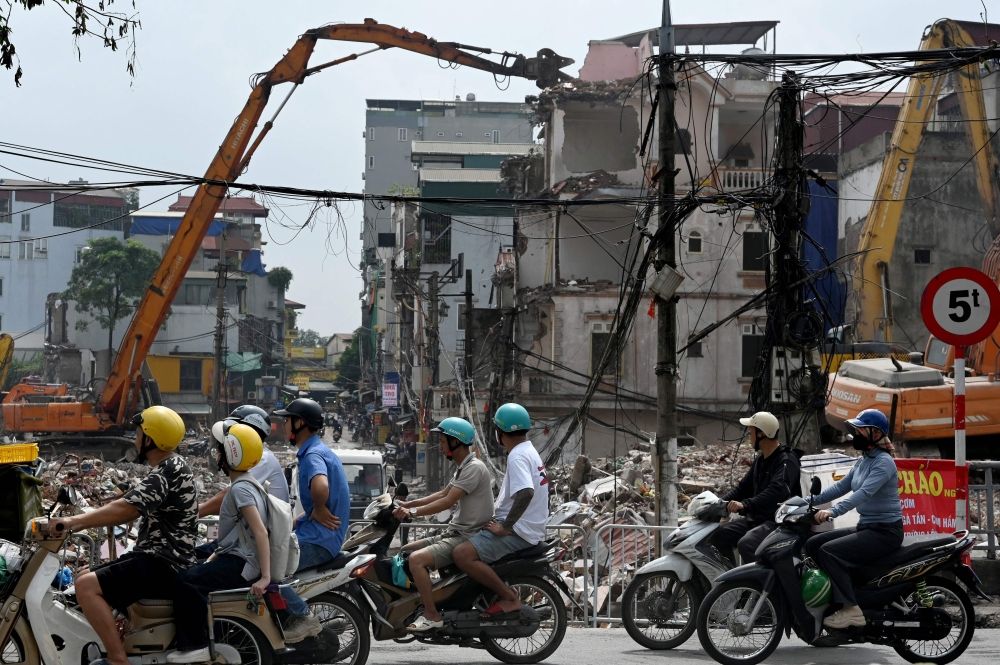
People ride motorcycles past a demolition site of former residential buildings to make way for an expanded road network in Hanoi May 18, 2026. — AFP pic
But the rapid pace of change and lack of public consultation has bred resentment.
The master plan ran to more than 1,000 pages, according to Labbe, but was only “opened for comment for something like 10 or 15 days”.
“Plans didn’t use to be approved and implemented so fast,” she said.
‘No greater pain’
Ho Chi Minh City also has a 100-year master plan, as Vietnam embarks on an infrastructure drive that parallels its giant Communist neighbour to the north, both in scale and execution.
“To me, the influence of Chinese planning is very clear,” said Labbe.
Retired house cleaner Phan received her final eviction notice in February and her four-storey home is slated for demolition this week.
The 10-person, three-generation household split up and moved in with other relatives.
Authorities offered a slight discount on a much smaller apartment costing US$76,000.
But because like many they did not have title to the land under their home, they were only compensated US$19,000 for building costs.
“So now the family is in a very difficult situation and has to borrow money,” said Phan, 69.
“Our family used to eat together, sit together, and live happily as three generations under one roof,” she said, breaking into tears.
“Now the family is broken apart, everyone scattered in different places. There is no pain greater than this.” — AFP
These were the details of the news Vietnam wants a futuristic megacity by 2045 — and Hanoi residents are paying the price for this day. We hope that we have succeeded by giving you the full details and information. To follow all our news, you can subscribe to the alerts system or to one of our different systems to provide you with all that is new.
It is also worth noting that the original news has been published and is available at Malay Mail and the editorial team at AlKhaleej Today has confirmed it and it has been modified, and it may have been completely transferred or quoted from it and you can read and follow this news from its main source.