Hello and welcome to the details of South Korea rolls out world’s first full AI law, forcing labels on deepfakes and now with the details
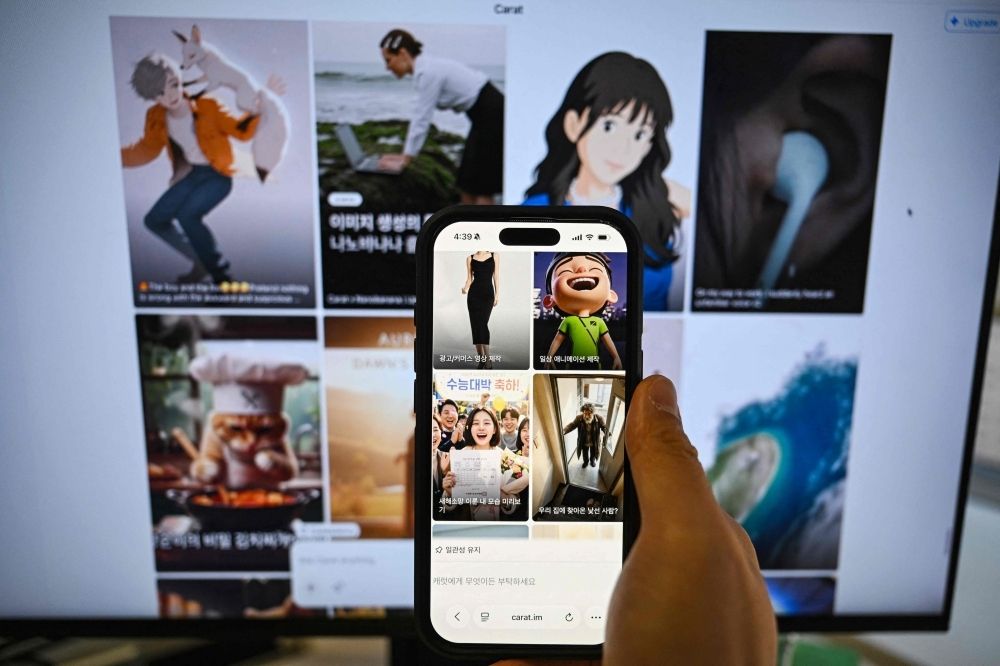
Nevin Al Sukari - Sana'a - This photo illustration taken in Seoul shows AI images created by Carat, a South Korean generative AI service, and its webpage. — AFP pic
SEOUL, Jan 22 — South Korea became the first country to have a wide-ranging law regulating artificial intelligence take full effect starting today, including specific provisions targeting deepfakes.
The country, home to memory chip powerhouses Samsung and SK hynix, has said it aims to join the United States and China as one of the top three AI powers.
“The AI Basic Act comes into full effect today,” President Lee Jae Myung said.
The law requires companies to give users advance notice when services or products use generative AI.
It also says they must clearly label content, including deepfakes, that cannot readily be differentiated from reality, among other requirements.
The act, passed in December 2024, is meant to “establish a safety- and trust-based foundation to support AI innovation”, the Ministry of Science and ICT said in a statement.
Violations are punishable by a fine of up to 30 million won ($20,400).
South Korean media said it was the first comprehensive AI regulation law in the world to take effect.
The ministry described it as the second of its kind in the world to be enacted.
The European Parliament says it adopted the “world’s first rules on AI” in June 2024, but these are coming in more gradually and will only become completely applicable in 2027.
For the past year, however, the European Union has allowed regulators to ban AI systems deemed to pose “unacceptable risks” to society, under its Artificial Intelligence Act.
That could include identifying people in real time using cameras in public spaces, or evaluating criminal risk based on biometric data alone.
‘Unknown era’
South Korea has said it will triple spending on artificial intelligence this year.
The Asian nation’s new legislation designates 10 sensitive fields—including nuclear power, criminal investigations, loan screening, education and medical care—that are subject to heightened requirements on AI transparency and safety.
“Sceptics fear the regulatory consequences of the law’s enactment,” Lim Mun-yeong, vice chairman of the presidential council on national AI strategy, said this week.
“The nation’s transition toward AI, however, remains in its infancy with insufficient infrastructure and systems,” Lim said, adding that “acceleration of AI innovation is needed to explore an unknown era”.
If necessary, “the government will accordingly suspend regulation, monitor the situation and respond appropriately”, he said.
Deepfakes have returned to global attention in recent weeks after Elon Musk’s Grok AI chatbot drew outrage and bans in several countries for enabling users to generate sexualised images of real people, including children.
South Korea’s science ministry said applying digital watermarks or similar identifiers to AI-generated content was a “minimum safety measure to prevent the misuse of technology—including manipulated AI-generated videos, or deepfakes”.
“It is already a global trend adopted by major international companies,” the ministry said.
In October, California signed a landmark law regulating AI chatbots, defying a push from the White House to leave such technology unchecked.
It followed revelations about suicides by teenagers who had used chatbots before taking their own lives.
California’s law requires operators to implement “critical” safeguards when users interact with their AI chatbots, and opens an avenue for people to file lawsuits if failures to do so lead to tragedies. — AFP
These were the details of the news South Korea rolls out world’s first full AI law, forcing labels on deepfakes for this day. We hope that we have succeeded by giving you the full details and information. To follow all our news, you can subscribe to the alerts system or to one of our different systems to provide you with all that is new.
It is also worth noting that the original news has been published and is available at Malay Mail and the editorial team at AlKhaleej Today has confirmed it and it has been modified, and it may have been completely transferred or quoted from it and you can read and follow this news from its main source.