
Thank you for reading the news about Gulf aviation hubs remain critical to global industry despite regional tensions, says Jetex CEO and now with the details
Jeddah - Yasmine El Tohamy - Gulf aviation hubs remain critical to global industry despite regional tensions, says Jetex CEO
ROME: The private aviation sector and the important role of Gulf air-transport hubs are not at risk and will rebound as soon as the “storm goes down,” Adel Mardini, the founder and CEO of Jetex, told Arab News, referring to the recent turmoil in the region.
Speaking on the sidelines of the opening day of the Future Investment Initiative Priority Europe summit in Rome, he said the private aviation sector had continued to grow despite the geopolitical tensions in recent months.
“The aviation industry has been changed big time after COVID, and a lot of people moved from commercial alone to private aviation,” he said.
With each successive crisis air travel has faced, he added, more people were recognizing the importance and value of private aviation and it was no long viewed simply as an extravagant status symbol for the wealthy.
While commercial air traffic in the Middle East declined sharply in April amid disruptions related to the conflict with Iran, for example, Mardini said that private aviation had continued to grow.
“People had no other choice than to choose a private jet,” he said, explaining that when people wanted to leave the region when the conflict with Iran began at the end of February they increasingly sought out private flights when commercial airlines grounded planes.
As a result, he added, there was an influx of new clients to the private aviation sector which, almost counterintuitively given the broader context, “made our industry stronger and stronger.”
According to Fortune Business Insights, the global business jet market is projected to be worth $50.6 billion this year, with an active fleet of 24,000-25,000 aircraft and flight activity significantly above pre-COVID benchmarks.
While the US dominates the sector, the Middle East and North Africa region has emerged as a fast-growing market, driven by ultra-high-net-worth individuals, corporate conglomerates and sovereign wealth, and the region functions as a long-range, ultra-luxury aviation hub.
“We are a global (business with) 44 locations around the world. For sure, the region is an extremely important region,” Mardini said.
He predicted that regional aviation would rebound beginning in September, when the local high season for tourism begins and a conclusive deal between Washington and Tehran has hopefully been signed.
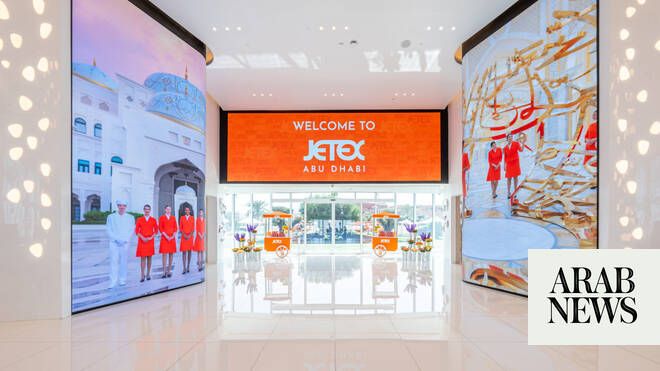
In the meantime, the crisis has had little effect on Jetex, Mardini said, because the business has positioned itself not as an aviation company but as a lifestyle brand.
“Jetex is the first company who brought hospitality to the aviation industry,” he added. “We are so proud of this achievement. We changed the concept of the ‘passenger’ to ‘guest.’ When you come to Jetex, you will see the guest experience team, butler team, (food and beverages), housekeeping; it’s like a hotel.”
Syrian-born Mardini launched Jetex in Dubai in 2005 having foreseen the trend toward a strong regional expansion of the aviation industry. Two decades later, Jetex serves 44 countries across five continents, with plans to expand into electric vertical take-off and landing (or eVTOL) aircraft and urban air mobility.
“The industry will grow for sure,” Mardini said. “And because Jetex is adapting to any changes in the market, this is why we are investing in infrastructure.”
The Gulf region is spearheading advances in eVTOL, with authorities investing in infrastructure and welcoming innovation in the technology.
“They’re hands on and know what they want,” Mardini said, adding that the recent opening of Jetex’s first Saudi hub, at the Red Sea International Airport, is testimony to this.
“Within a month — and we are at a very early stage — we handled more than 100 flights,” he revealed. “That’s very promising.”
As it wins more tenders the company plans to expand and open additional facilities in the Kingdom, at locations such as King Khalid International Airport in Riyadh.
“We are ready and we are eager and hungry to be in Saudi (Arabia),” Mardini said. “We are waiting for the opportunity.”
These were the details of the news Gulf aviation hubs remain critical to global industry despite regional tensions, says Jetex CEO for this day. We hope that we have succeeded by giving you the full details and information. To follow all our news, you can subscribe to the alerts system or to one of our different systems to provide you with all that is new.
It is also worth noting that the original news has been published and is available at Arab News and the editorial team at AlKhaleej Today has confirmed it and it has been modified, and it may have been completely transferred or quoted from it and you can read and follow this news from its main source.


