
Thank you for reading the news about Saudi support is a lifeline for Yemen’s state institutions, UN envoy tells Security Council and now with the details
Jeddah - Yasmine El Tohamy - Saudi support is a lifeline for Yemen’s state institutions, UN envoy tells Security Council
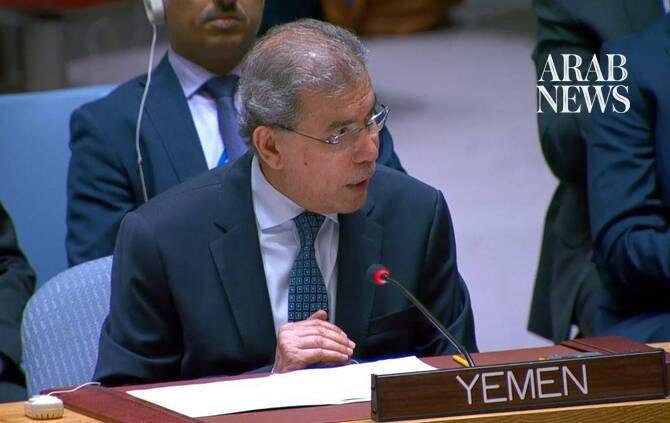
NEW YORK CITY: Yemen’s permanent representative to the UN, Abdullah Al-Saadi, told the Security Council on Thursday that Saudi Arabia’s sustained political, economic and humanitarian support has been essential in keeping state institutions functioning, even as he delivered a sweeping condemnation of the Houthis and their backers in Iran.
Briefing the council, the presidency of which is held by Denmark this month, Al-Saadi said Yemen’s state institutions “would not have been able to remain resilient and able to fulfill their obligations without the sincere fraternal support” of the Saudi leadership. He credited Riyadh with helping to preserve the cohesion of the institutions, alleviate humanitarian suffering, and funding “vital projects” that strengthened the country’s prospects for recovery.
Yemen’s tragedy “was not preordained by fate but rather was the outcome of the coup waged by the Houthi militias,” he said as he accused the militant group of choosing “chaos and war over the stability of the state; sectarianism over equal citizenship.”
The Houthis had “chosen to bet on the agendas of the Iranian regime, to the detriment of the Yemeni people and its aspiration for security, stability and dignity,” Al-Saadi added.
The militia had undermined state institutions, targeted the national economy, recruited thousands of children into their ranks, plundered resources and humanitarian assistance, and resorted to arbitrary detentions and “gross human rights violations,” he said.
He accused the Houthis of attempting to establish “an air bridge between Sanaa and Tehran” for the transfer of weapons and experts, using Mahan Air, a carrier affiliated with Iran’s Islamic Revolutionary Guard Corps and already under UN sanctions.
Unauthorized Iranian flights had landed in Sanaa and Hodeidah without the authorization of the Yemeni government, Al-Saadi said, in violation of the country’s sovereignty; a violation he noted the council had, rightly, condemned.
He also listed a string of recent attacks by the Houthis, including strikes on commercial vessels in the Red Sea and Bab Al-Mandab Strait; attacks on civilians inside Saudi Arabia; drone and ballistic missile strikes on military outposts, civilian infrastructure and displacement camps in Yemen; and an assault on the country’s Al-Mokha port.
On Tuesday, Houthi forces attacked a vessel carrying food supplies to Yemen, killing four members of its crew — three Pakistanis and an Indonesian — and wounding four others, then fired a second missile at rescuers, wounding one of them.
Al-Saadi described this as proof of the group’s “disregard for the norms and rules governing maritime navigation,” and said it showed the danger of allowing missile, drone and other weapons capabilities to remain “outside the control of state institutions.”
The Houthis had spent years “propagating allegations of a blockade to circumvent their responsibility for the worsening living conditions for the Yemeni people,” he said, when it was the militia itself that was attacking Yemen’s ports, disrupting commerce and worsening the suffering of the population.
The group had turned Yemeni territory into “a platform to serve the (Revolutionary Guard) agenda to blackmail the international community and threaten international trade and navigation,” he added.
The Houthis had reneged on a UN-brokered agreement to release 1,600 prisoners and detainees, Al-Saadi said, describing this as part of their pattern of “politicizing humanitarian issues” and using them “as tools for bargaining and blackmail.”
The group continues to arbitrarily detain UN personnel, humanitarian workers, representatives of civil society, and diplomatic staff “in defiance of the demands of this council and the international community,” he added as he urged the council to press for the immediate, unconditional release of the detainees.
Condemnation of the Houthis by the council, while welcome, “must be coupled with implementation” of resolutions 2140 and 2216 that target them, Al-Saadi said, including efforts to prevent the smuggling of weapons to the militia, and to hold violators of the UN’s sanctions regime accountable.
“The continuous possession of these weapons and technologies by Houthi militias runs counter to the requirements of sustainable peace,” he added, describing it as representing “a permanent threat to Yemen, neighboring countries and international waterways.”
He concluded by quoting an appeal by the chairperson of Yemen’s Presidential Leadership Council, Rashad Al-Alimi, to the Security Council for it to “give the state a chance.”
Al-Saadi characterized this request by Yemeni authorities as representing a defense of core principles, the protection of civilians, state sovereignty, freedom of navigation, and the rejection of the use of missile and drone attacks to force political gains, rather than a simple call for solidarity.
These were the details of the news Saudi support is a lifeline for Yemen’s state institutions, UN envoy tells Security Council for this day. We hope that we have succeeded by giving you the full details and information. To follow all our news, you can subscribe to the alerts system or to one of our different systems to provide you with all that is new.
It is also worth noting that the original news has been published and is available at Arab News and the editorial team at AlKhaleej Today has confirmed it and it has been modified, and it may have been completely transferred or quoted from it and you can read and follow this news from its main source.


