
Thank you for reading the news about Taif’s historic markets: A living heritage of traditional crafts and now with the details
Jeddah - Yasmine El Tohamy - MAKKAH: In the narrow alleyways of the historic district in the heart of Taif, within the old souk and its winding streets, time seems to stand still, retelling the stories of generations past.
The air is thick with the scent of Taif roses, mingling with the aroma of cardamom and authentic Arabian spices, while the footsteps of visitors blend with the sound of chisels and hammers as craftsmen work with copper and iron.
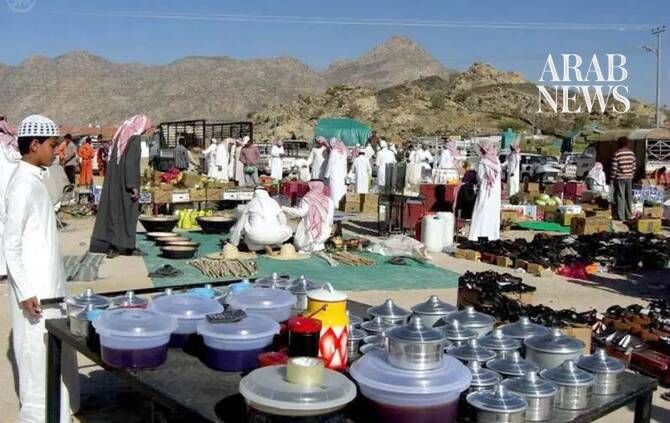
Taif’s old markets are not merely centers for exchanging goods; they are living testaments to a rich human and cultural heritage, reflecting the city’s status for centuries as a crossroads for caravans and a major stop along trade and pilgrimage routes.
Wandering through these markets takes us deeper into the history of the old historic souk.
In this context, Saad Al-Sharif, a researcher specializing in modern history, explains that Taif’s historic markets were never simply shops selling material goods, but rather social and cultural spaces that enriched the region’s cultural heritage.
“Taif is distinguished by its exceptional geographical location, which made it the eastern gateway to Makkah and a historical summer resort in the Arabian Peninsula,” Al-Sharif said. “This location was reflected in the diversity of its old markets, such as Souq Al-Balad, Souq Al-Anqari, and Souq Okaz. These markets served as gathering places for tribes, poets, merchants, and other segments of society.
“The architectural layout of these markets reflected a precise social philosophy. Each craft or commodity has its own designated market or lane, such as the goldsmiths’ market, the market for ghee, local cheese, and honey, and the leather market.
“This facilitates easy access for buyers and fosters a sense of cooperation and self-regulation among craftsmen, all under the supervision of what was traditionally known as the ‘market leader,’”Al-Sharif added.
In the corners of small shops with antique wooden doors, heritage is showcased in its most beautiful form through the hands of artisans who strive to preserve their ancestors’ professions. Inside his shop, which is only a few square meters in size, works Adel Al-Nimri, a skilled craftsman specializing in the traditional distillation and production of Taif rose oil.
“I inherited these crafts from my father and grandfather. Rose distillation is not just a job; it is an art and an emotion. We use traditional copper pots and earthenware blocks for distillation, so that our children inherit this secret, and rose oil and rose water remain the distinctive mark of Taif throughout the world,” he said.
Just steps away, in the blacksmiths and coppersmiths market, the rhythmic clang of Abu Fahd’s hammer echoes. He spends his days at the bellows, crafting traditional Arab daggers, shovels, and antique copperware.
“Despite the advent of modern machinery and rapid industrial production, a handmade piece possesses a spirit that no machine can replicate. Our customers aren’t just looking for the product itself; they seek quality, precision, and the history that pulsates in every curve of the copper or iron piece,” he affirmed.
The handicrafts in Taif’s markets are diverse, encompassing the tailoring of traditional cloaks (bishts) and vests, the production of leather goods such as antique shoes and bags, and the carpentry of traditional windows and doors adorned with geometric and floral designs that showcase the skill of local artisans.
Today, Taif’s historic markets are gaining a new dimension thanks to ongoing development and restoration projects aimed at revitalizing the city’s historic heart while preserving the identity of its stone buildings and wooden windows.
“The current focus on historical markets aligns with Saudi Vision 2030’s emphasis on national identity and cultural heritage. Maintaining these markets and supporting the remaining artisans is not merely nostalgia, but a sustainable economic and cultural investment that will make Taif a unique tourist and cultural destination, blending natural beauty with a rich history,” Saad Al-Sharif added.
The scene in Taif’s historic markets remains a living portrait of authenticity and modernity, where the stories of researchers and the evidence of history intertwine with the determination of artisans, ensuring that these markets remain a living testament to the spirit of a city whose memory never sleeps.
These were the details of the news Taif’s historic markets: A living heritage of traditional crafts for this day. We hope that we have succeeded by giving you the full details and information. To follow all our news, you can subscribe to the alerts system or to one of our different systems to provide you with all that is new.
It is also worth noting that the original news has been published and is available at Arab News and the editorial team at AlKhaleej Today has confirmed it and it has been modified, and it may have been completely transferred or quoted from it and you can read and follow this news from its main source.


