Hello and welcome to the details of ‘Not something you rush’: Allies fear a hasty US–Iran framework could backfire, trapping talks in technical deadlock and now with the details
- Nevin Al Sukari - Sana'a - European allies fear US team may strike superficial Iran deal
- Technical disputes over uranium enrichment and sanctions relief remain unresolved, diplomats warn
- Iran seeks guarantees, while Europe urges broader involvement in talks
PARIS, April 21 — European allies fear an inexperienced US negotiating team is pushing for a swift, headline-grabbing framework deal with Iran that could entrench rather than resolve deeper problems, diplomats with past experience dealing with Tehran said.
They worry Washington, eager to claim a diplomatic win for President Donald Trump, could lock in a superficial agreement on Iran’s nuclear programme and sanctions relief, then struggle through months or years of technically complex follow-on talks.
“The concern isn’t that there won’t be an agreement,” said a senior European diplomat, one of eight who spoke to Reuters who have previously worked on the nuclear file or continue to do so. “It’s that there will be a bad initial agreement that creates endless downstream problems.”
Responding to a series of questions from Reuters, ranging from negotiating style and team to objectives and the potential dangers of a quick deal, the White House rejected the criticism.
“President Trump has a proven track record of achieving good deals on behalf of the United States and the American people, and he will only accept one that puts America first,” spokeswoman Anna Kelly said.
2015 nuclear deal abandoned by Trump
Diplomats from France, Britain and Germany — which began negotiating with Iran in 2003 — say they have been sidelined.
From 2013 to 2015, the three worked with the United States to secure a deal on curbing Iran’s nuclear programme in exchange for sanctions relief, known as the Joint Comprehensive Plan of Action.
Trump withdrew from the accord — the signature foreign policy agreement of his predecessor Barack Obama — in 2018, during his first term, calling it “horribly one-sided”.
After 40 days of airstrikes, US and Iranian negotiators opened talks in Islamabad earlier this month, again focused on the familiar trade-off of nuclear restrictions for economic relief. There were some signs in the Pakistani capital on Sunday of preparations for a resumption of face-to-face negotiations.
Diplomats say deep mistrust and sharply different negotiating styles raise the risk of a fragile framework neither side can sustain politically.
“It took us 12 years and immense technical work,” said Federica Mogherini, who coordinated the talks from 2013 to 2015. “Does anyone seriously think this can be done in 21 hours?”
High-level deal, light on detail
The diplomats said a skeletal agreement may be achievable, built around a nuclear package and an economic package. But they warned the nuclear component remained by far the most contentious.
“The Americans think you agree on three or four points in a five-page document and that’s it, but on the nuclear file, every clause opens the door to a dozen more disputes,” a second European diplomat said.
Talks are focusing on Iran’s stockpile of roughly 440 kilogrammes of uranium enriched to 60 per cent, material that could be used for several nuclear weapons if further enriched.
The favoured option is “downblending” inside Iran under International Atomic Energy Agency supervision. Another is a hybrid approach, with some material shipped abroad.
Turkey and France have been mentioned as possible destinations. Shipping material to the United States would be politically difficult for Iran, while Russia is unattractive to Washington, two of the diplomats said.
Even those options would require lengthy negotiations over recovering material possibly buried by airstrikes, verifying quantities and transporting it securely.
Iran has also floated storing material abroad for a fixed period.
“Whatever happens now is only a starting point,” said a Western diplomat previously involved in nuclear talks. “That’s why the 2015 JCPOA ran to 160 pages.”
Beyond stockpiles lies the deeper dispute over Iran’s right to enrich uranium at all. Trump has publicly pushed for zero enrichment, while Iran insists it has the right to enrich uranium for civilian purposes and denies seeking a bomb.
One possible compromise would be a temporary moratorium followed by resumption at very low levels under strict conditions.
Europeans stressed that a central role for the IAEA, including intrusive verification and unrestricted access, was essential.
“A negotiation with Iran is meticulous and subtle: every word matters,” said Gérard Araud, France’s chief negotiator from 2006 to 2009. “That’s not something you rush.”
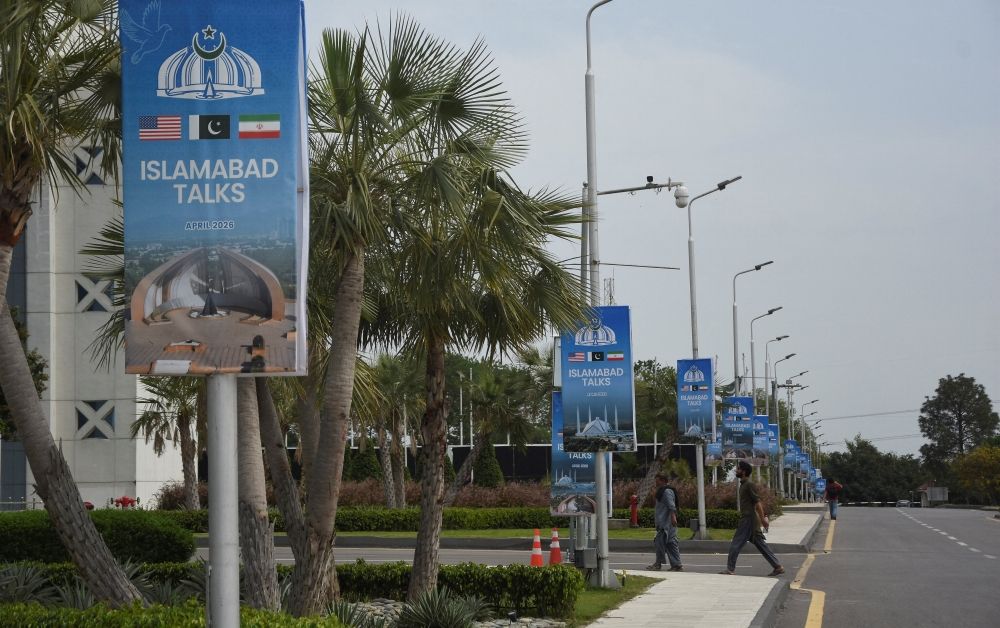
Hoardings displaying flags of the US, Pakistan and Iran, as Pakistan prepares to host the US and Iran for the second phase of peace talks in Islamabad April 18, 2026. In the short term, Iran wants access to limited frozen funds overseas. Broader sanctions relief would come later and require European buy-in, diplomats said, as Iranian leaders see European trade as critical over the long term. — Reuters pic
Sanctions relief and face-saving
The economic track focuses on lifting sanctions and unfreezing Iranian assets.
In the short term, Iran wants access to limited frozen funds overseas. Broader sanctions relief would come later and require European buy-in, diplomats said, as Iranian leaders see European trade as critical over the long term.
Officials say Washington is again separating an agreement in principle from its painstaking follow-up, an approach they say risks misreading Iranian political culture.
“These talks aren’t a real-estate deal settled with a handshake,” said a senior regional diplomat briefed by Tehran, referring to the background of Trump’s main negotiators Steve Witkoff and Jared Kushner. “They involve sequencing, sanctions relief and reciprocal nuclear steps.”
The war has hardened Iran’s stance, diplomats said, showing it can absorb pressure even as it seeks financial relief.
Tehran’s top demand is a non-aggression guarantee after being attacked by the US and Israel during earlier diplomatic efforts.
The concern is shared among US allies. Gulf states want Iran’s ballistic missiles and proxy activities addressed, while Israel is pushing for maximal constraints.
Iran, by contrast, sees its remaining missile capability as a vital deterrent after the war degraded its forces.
Diplomats say demanding total abandonment would be unrealistic without broader security guarantees.
A senior Trump administration official said Washington’s redlines included ending uranium enrichment, dismantling major enrichment facilities, recovering highly enriched uranium and accepting a broader de-escalation framework involving regional allies.
Europe on the sidelines — but still relevant
European officials acknowledge they sidelined themselves in part by pushing last year to reimpose UN sanctions and by designating Iran’s Revolutionary Guards a terrorist organisation.
But they say their decision to stay out of the conflict has not gone unnoticed in Tehran.
“There’s simply not enough expertise in this US team,” said one European official, noting that roughly 200 diplomats, financial and nuclear experts were involved in the 2015 talks. “We’ve worked on this file for two decades.”
A White House official said officials from the National Security Council, State Department and Defence Department were present in Islamabad and remained involved. — Reuters
These were the details of the news ‘Not something you rush’: Allies fear a hasty US–Iran framework could backfire, trapping talks in technical deadlock for this day. We hope that we have succeeded by giving you the full details and information. To follow all our news, you can subscribe to the alerts system or to one of our different systems to provide you with all that is new.
It is also worth noting that the original news has been published and is available at Malay Mail and the editorial team at AlKhaleej Today has confirmed it and it has been modified, and it may have been completely transferred or quoted from it and you can read and follow this news from its main source.